
CoverUp Tattoo Guide. Exploring Design, Healing, Laser Options, and Choosing the Right Artist

Updated: Jun 22
If you’re thinking about getting a coverup tattoo, there’s a good chance you’ve already spent some time wondering what is actually possible, what is not, and how to avoid making the situation worse.
We get a lot of cover-up tattoo requests at Logan Square Tattoo. Some are small and straightforward. Some are large, dark, scarred, or heavily saturated. Some involve laser first. Some don’t. The important thing is that cover-ups are their own thing. They are not just regular tattoos placed on top of old tattoos.
A successful coverup tattoo comes down to three things: smart design, careful application, and experience. If those three things are there, a lot is possible. If they are not, it is very easy to turn a workable tattoo into a much harder problem.
This blog post is pretty detailed. There’s a FAQ at the end to answer most common questions so feel free to skip to that.
What a Coverup Tattoo Actually Is
A coverup tattoo is not about putting a fresh layer of ink over an
old tattoo and making it disappear like paint on a wall. Tattoo pigment does not work like that.
What a good tattoo cover-up actually does is obscure, camouflage, and break up the old tattoo so your eye reads the new design instead of the old one. That is a big difference, and it is why cover-up tattoos take planning.
Old pigment still exists in the skin. As the new tattoo heals and settles, the original tattoo can still influence how the final result looks. That is why a strong coverup tattoo artist is thinking not just about how the tattoo looks fresh, but how it is going to look healed months down the line.
Why Cover-Up Tattoos Are More Technical Than Fresh Tattoos
Tattooing on clean skin gives an artist a lot more freedom. With a cover-up tattoo, the artist has to work with whatever is already there. Old and raised lines, traumatized skin, limitations with placement because of existing tattoos can all cause additional design and application challenges and make coverup tattoos more technical than standard tattooing. It is also why choosing an experienced cover-up tattoo artist matters so much, especially if you are looking for a coverup tattoo in Chicago and want something that still looks good once it heals.
At Logan Square Tattoo, cover-up work is a big part of what we do. Artists here regularly handle everything from simple name cover-up tattoos to larger reworks and full cover-up sleeve tattoos.


Good Cover-Up Tattoos Start With Flexibility
If you want the best result, it helps to come into the process with an open mind.
That does not mean you should not have ideas. You should. But with a coverup tattoo, success often depends on being flexible about things like
Size - bigger is usually better
subject matter - a realism tattoo with a lot of detail and scales will work well to hide an old tattoo. A fineline floral piece probably won’t.
Placement - obviously it will be placed over the existing piece, but where else the new tattoo extends to can make or break the composition.
Contrast - strong contrast helps hide old tattoos.
added background or supporting elements - being able to hide the old piece in a less important part of the new design dill draw the attention away from the coverup.
For example, if you want to cover an old name with a portrait, that may be possible. But if that name sits right where the lightest part of the face needs to be, it probably is not going to cover the old design up and may in fact draw more attention to it. Using other parts of the design like darker hair, darker clothing, ornament, florals, or other elements could help camouflage the old tattoo in a natural way.
The more open you are to your artist’s input, the better your cover-up tattoo ideas usually turn out.
The Three Things That Make a Cover-Up Tattoo Successful
At the end of the day, there are three parts to any successful cover-up tattoo: design, application, and longevity.
Design Is the Most Important Part of a Coverup Tattoo
More than anything else, a successful coverup tattoo is a design problem.
A good design does not just bury the old tattoo under a dark shape. It uses movement, contrast, texture, and composition to visually break up what is already in the skin. The goal is to make the old tattoo unreadable, not to force as much dark ink into the area as possible.
A strong cover-up tattoo design usually does a few things well:
places dark values where the old tattoo needs to disappear
avoids putting light open space over the darkest old pigment
breaks up readable shapes like names, letters, or symbols
repeats dark and light areas throughout the composition
looks like a strong tattoo on its own, not an obvious fix
This is why a lot of cover-up tattoos need to be larger than the original tattoo. If the new piece is too small, it often ends up looking muddy or overly heavy in one spot. More room usually gives us more ways to camouflage the old tattoo without making the new tattoo look forced.
Application
Tattooing over old pigment or scar tissue is more difficult than tattooing fresh skin. It takes experience to know how to handle previously tattooed skin, how much to saturate, and when to stop.
Good application means:
understanding how already-tattooed skin takes ink
working carefully over scar tissue
avoiding unnecessary trauma
knowing when multiple sessions are the smarter option
being realistic about what the skin can handle
Longevity
A cover-up that looks good fresh but falls apart or doesn’t hide the old tattoo once healed is not a successful cover-up.
Longevity depends on an artist understanding a number of things that mostly are learned through experience and observation.
How new pigment will settle in over existing pigment over time. What a fresh coverup looks like out the door is not how it will look in two months.
Understanding how different pigments age. What colors might fade or change. How will that effect the coverup?
How the clients skin tone will influence and color that is used in a coverup
The strength and opacity of different pigments. Not all colors are the same and some work better for coverups than others. Likewise some are easier to cover than others.
having experience with healed cover-up results. This is key to foreseeing what a tattoo will like like when fully healed.

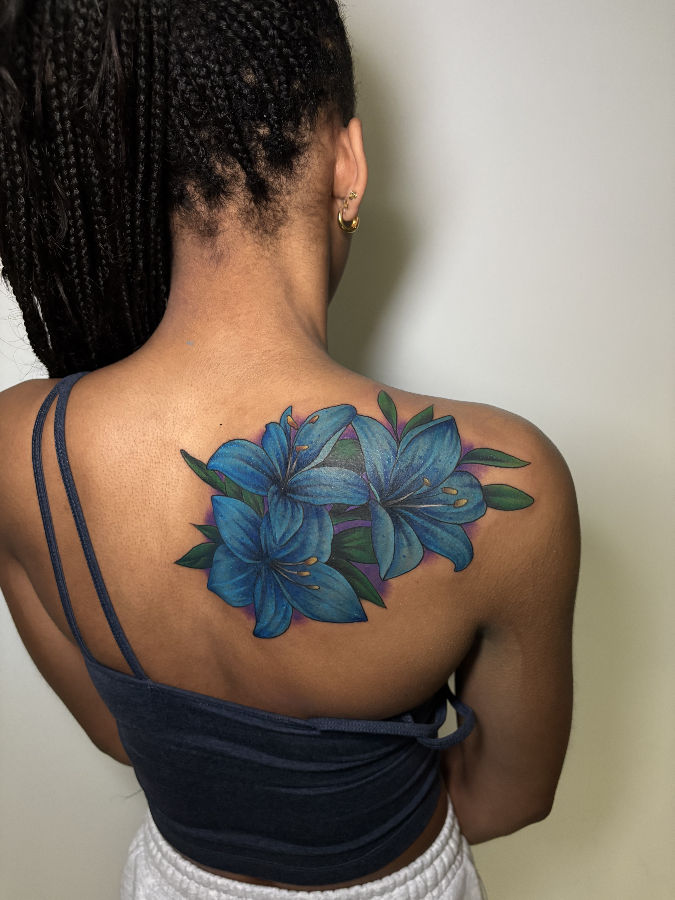


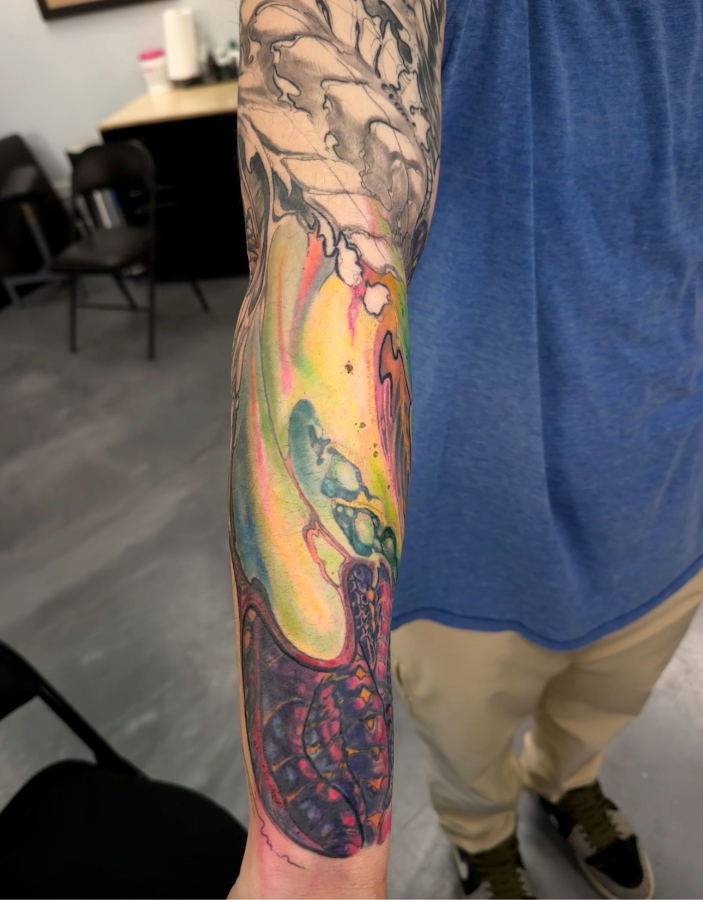
Other things to consider when getting a coverup tattoo
Healing Matters More Than Most People Think
One of the biggest mistakes people make when judging cover-up tattoos is focusing only on fresh photos.
Fresh tattoos can look much more opaque than they will once healed. Light colors packed over dark tattoos can look like they solved the problem right away, then heal in a way that lets the old tattoo come back through. That is normal if the design and application were not built with healing in mind.
That is why healed work matters so much when you are choosing a coverup tattoo artist. Fresh tattoos show what happened that day. Healed tattoos show whether the artist actually understood the assignment.
If you are looking for a coverup tattoo artist in Chicago, ask to see healed examples whenever possible.
Scar Tissue Changes Everything
A lot of tattoos have some amount of scar tissue, even if it is not obvious in a photo.
That scar tissue can affect:
how the skin takes pigment
how smooth dark areas heal
whether old linework stays raised
how much trauma the skin can handle
whether the project should be done in multiple sessions
This is also where scar cover-up tattoo experience matters. Tattooing over scarred skin or using tattooing to camouflage scarring takes a gentler approach. If someone is too aggressive, they can make the texture worse and make the cover-up harder to read over time. An artist who has experience working with scar tissue can use a multi session approach to attempt to break up some of the scar tissue allowing for better color saturation for the coverup. Scars are complicated and can require their own type of coverup/camouflaging depending on their severity.
Different options for large or extra complicated coverup tattoo projects.
Blackout Tattoos Are Not Always the Answer
Often we get people asking about a blackout tattoo cover-up as a quick solution.
Backing out a tattoo is basically what it sounds like, tattooing solid black over an existing design in order to cover it up.
Blackout tattoos can absolutely be a strong aesthetic choice. But they are not a guaranteed way to make old tattoos disappear. Underlying tattoos can still show through, especially if there is scar tissue or heavy linework underneath. Sometimes those older tattoos become visible by texture, value shifts, or raised areas in the skin.
When I get asked to black out an existing piece I always ask if they are interested in blacking it out because they want that look, or if they just don’t know that they have other options. If it’s the former and you want some large solid blackwork, great! It’s good to note that even in solid blackwork/blackouts there is options and flexibility for how you want that to look, we dive a bit deeper into that in our blackwork section here and a consultation with a blackwork artist like Gifford or December can help you explore your options.
If you like the layered blackout look, that is one thing. If you are hoping blackout will behave like white paint over black marker, that is usually not how skin works.
The below example shows a more long term blackout coverup project done by Gifford. The first photo shows the existing tattoos. You can see they are very heavy and there is minimal negative space to create a new image. In the second photo a heavy and fully saturated layer of black was tattooed over the old design. Some breaks were left between the black shapes for future additions. The tattoo was left to heal and settle for an additional year. Roughly a year later after the skin was fully healed and all the ink was given a chance to settle together - an additional layer of white was added to give the shapes a more 3d effect. More black was added to darken parts of it further, and some color was added to the breaks between shapes. the third photo shows the results after the white had healed. Additional layers of white could push the effect even further, so there will be more limited returns with additional layers. this is a great example of blackwork and blackout tattooing that still keeps some design and flow to the project.
full sleeve coverup tattoo before picture blackout tattoo freshly tattooed settled black out tattoo and color overlay healed
Large Cover-Up Tattoos and Sleeve Projects
A cover-up sleeve tattoo or large-scale rework usually involves more strategy because there is less open skin left to work with. In those cases, the process often becomes less about hiding one tattoo and more about rebuilding the whole visual structure of the area.
A typical large coverup up project will involve multiple sessions with proper healing between sessions. It will be important to design around the existing pieces, utilizing the lighter areas to create new focal points, or, in some cases, making the focal points the darker areas. It can be a complex design process and the end result should be a piece that looks balanced and maintains a good flow with the body.
When we talk to clients about larger cover-up work, one of the first things we want to know is what success looks like to them. Do they want the old tattoo completely unreadable? Are they okay with a darker sleeve overall? Are they open to blackwork, texture, or heavier design elements?
Those answers help shape the new idea. Both Gifford and Pablo have extensive experience in large and small coverup projects
When Laser Tattoo Removal for Cover-Up Makes Sense
Sometimes a tattoo is simply too dark or too saturated to cover cleanly in the way a client wants. That is where laser tattoo removal for cover-up or laser lightening can be helpful.
Laser can give us more room to work, especially if the goal is a softer black-and-grey tattoo, a portrait, or anything that needs lighter value areas. It can also help break up very dark old tattoos so the final cover-up tattoo does not need to be quite as heavy.
Laser may make sense if:
the existing tattoo is very dark
the new tattoo needs lighter values
the old tattoo sits in a key focal point
a straight cover-up would be too limiting
you want more options in the final design
That said, laser is not a shortcut. It adds cost, time, and healing to the project. It also means the skin needs to recover properly before tattooing over it. If you are combining laser with a tattoo cover-up, it is best to do that with a plan, not as an afterthought. Many of our artists have themselves gone through laser removal and are very familiar with the process and a great resource. Gifford has had a full sleeve removed as part of a lengthy coverup project
"I had laser removal off and on for about five years prior to starting my coverup. There was a lot of heavy saturation of color, mostly blues and greens which can be some of the hardest to lighten, so it took a good amount of time. Working through the removal process, and then the coverup over a still very visible existing sleeve was very informative and helps me in how I plan large coverup projects.”
We’ve worked extensively with local laser technicians at Removery to come up with a game plan and timeline for complicated coverup projects.
Why Rushing a Coverup Tattoo Is a Mistake
A lot of people seeking a coverup tattoo are ready to be done with the old tattoo immediately. We get that. Sometimes the tattoo has emotional baggage. Sometimes it was just badly done. Either way, it is tempting to rush.
That is usually where people get into trouble.
A rushed cover-up can turn a relatively manageable tattoo into a much larger, darker, more complicated one. Once more ink goes into the skin, options narrow. If the skin was initially traumatized, an inexperienced artist can cause more scar tissue. A poor spur of the moment design, or something picked off the wall can lead to large unbalanced dark areas, or the old tattoo showing through in a way that confuses the new design. Or in most cases, the old tattoo may be covered up, but it reads as an obvious coverup and everyone who sees it will be asking…what did you get covered up? Taking the time to find the right coverup tattoo artist who understands the time that goes into good coverup design will save you a lot of headache in the long run..
An old and faded tattoo that no longer speaks to the client Paige skillfully applies a stencil placing the darker inner part of the flower over the area needing with the lines done, the old piece is already lost and blends into the new one The new tattoo is well balanced and artfully hides the old piece.
This process collage shows a coverup by Paige. She has skillfully designed a new tattoo that hides the existing piece in the dark center of the flower and also balances that out with other dark areas in the bird and leaves. The attention is drawn away from the coverup and instead focused on the overall new piece. See more illustrative tattoo work from Paige here
Cover-Up Tattoos at Logan Square Tattoo
At Logan Square Tattoo, cover-up tattoos are a major part of what we do. We regularly work with clients looking for:
name cover-up tattoos
larger cover-up sleeve tattoos
scar cover-up tattoo work
guidance around laser tattoo removal for cover-up
help from an experienced cover-up tattoo artist
How to Start a Cover-Up Tattoo Consultation
If you are thinking about a coverup tattoo at Logan Square Tattoo, the best first step is simple: send us a photo.
When you fill out the booking form, let us know it is a cover-up tattoo project and include:
a clear photo of the current tattoo
the size and location
any inspiration or cover-up tattoo ideas
whether you are open to going bigger
whether you have had any laser done already or or planning to get any.
From there, we can figure out whether the project looks straightforward or whether it makes sense to bring you in for a more detailed tattoo cover-up consultation.
A great coverup tattoo is not about dumping more ink on top of a problem. It is about understanding what is already in the skin, designing around it intelligently, and applying the tattoo in a way that will still hold up once it heals.
Strong design, experienced application, patience, and clear discussions around goals and expectations are what make a great coverup. And we’re here to help you with that!
If you have a tattoo you are ready to move on from, send it over. Even if someone told you it could not be covered, there may be more options than you think.
Coverup Tattoo Chicago FAQ
Can my tattoo be covered?
Many tattoos can be covered, but the best approach depends on the size, darkness, placement, and condition of the skin. Some tattoos can be covered directly, while others may need a larger design or laser lightening first.
Do cover-up tattoos need to be bigger?
Usually, yes. A cover-up tattoo often needs more room so the old tattoo can be camouflaged without creating one dark, muddy area.
Do I need laser before a coverup tattoo?
Not always. Laser tattoo removal for cover-up is most helpful when the old tattoo is very dark or when the new design needs lighter values and more flexibility.
How do I start a tattoo cover-up consultation?
Send us a clear photo of your tattoo, include the size and location, and let us know it is a cover-up project. If needed, we may recommend an in-person consultation.
Do you do coverup tattoos in Chicago for larger projects too?
Yes. We work on everything from smaller name cover-up tattoos to larger reworks and cover-up sleeve tattoos, depending on the project and goals.


Comments